Checkers Set Up and Rules: A Complete Guide
For the checkers set up, place 12 pieces per side on the dark squares of the first three rows of an 8×8 board, leaving the middle two rows empty. Pieces move one square diagonally forward, must jump when a capture is available, and become kings on the far row. You win when your opponent has no pieces left or no legal move.
▶ Play Checkers · Draughts · Damas free →Checkers (also called draughts or damas) is simple to learn, but a wrong checkers set up makes every move that follows feel off. This guide covers the board, the starting position, how a turn works, how you win, and the edge cases that trip up new players. Everything here follows the standard English 8×8 rules used in our free browser game.
Quick answer: the checkers set up in five steps
- Place an 8×8 board between the players with a dark square in each player’s bottom-left corner.
- Give each player 12 pieces of one colour.
- Put each player’s pieces on the dark squares of the three rows closest to them.
- Leave the two middle rows empty.
- In English rules, the dark side moves first, then players alternate.
That’s the whole starting position. Now let’s look at each part in detail.
Checkers set up: board and pieces
The board
The board is an 8×8 grid of alternating dark and light squares, the same grid used for chess. All play happens on the dark squares, because pieces only move diagonally. Orientation matters. If the board is turned the wrong way, the dark squares end up in the wrong corners and the pieces will not line up. Check that each player has a dark square at their bottom-left.
The pieces
Each side has 12 identical pieces, usually called men until they are crowned. In our game they are two contrasting colours, typically dark (black or red) and light (white). A crowned piece is a king, shown with a marker so you can tell it apart.
The starting position
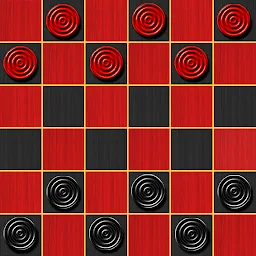
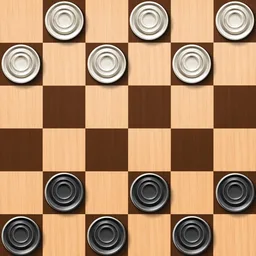
With the board oriented correctly, fill the dark squares in the first three rows from each player’s edge. That gives 4 pieces per row, or 12 per side. The two rows between the armies stay empty, so the first move is never a capture.
Quick check: if your pieces sit on light squares, or a back-row piece lands in the wrong corner, rotate the board 90 degrees.
How a turn works
Players alternate, one move per turn. On your turn you do exactly one of two things: make a simple move or make a capture.
Simple moves
A regular piece moves one square diagonally forward onto an empty dark square. It cannot move sideways or backwards. Kings are different: they move one square in any of the four diagonal directions.
Capturing by jumping
To capture, jump over an adjacent opponent piece and land on the empty square directly behind it, along the same diagonal. You can only jump if that landing square is empty. If your piece can keep jumping from its new square, it must continue, which creates a chain of captures in one turn.
Captured pieces are removed once your whole chain is finished. This also means you cannot jump the same piece twice in a single turn.
Capturing is compulsory
If any capture is available, you must make one. You cannot pick a quiet move instead. This rule is what makes checkers tactical, because you can force your opponent into a bad capture and then punish it.
In English rules you may choose any available capture, or any chain, even if another route would take more pieces. You do not have to take the biggest one. Some other rulesets do require the maximum, so check the variant before you play.
Becoming a king
When a regular piece ends its move on the far row (the row nearest your opponent), it is crowned. A king can move and capture backwards as well as forwards, which makes it much more powerful.
One edge case matters here. If a piece reaches the far row in the middle of a capture chain and can keep jumping as a regular piece, it keeps jumping as a regular piece and is not crowned. Crowning happens only if the move ends on that row.
Winning and drawing
How you win
You win when your opponent:
- has no pieces left, or
- has no legal move, for example because all their remaining pieces are blocked.
Being blocked counts as a loss even if the opponent still has pieces on the board.
How a game is drawn
On our site, a game is a draw in these cases:
- The same position (same board, same side to move) occurs three times.
- 80 half-moves (40 per side) pass with no capture and no regular piece moving.
- In 2-player mode, both players agree to a draw with the “Offer draw” button.
The second rule keeps endgames from dragging on forever when two kings chase each other around the board.
Special rules and edge cases
Which side moves first
In English checkers, the dark side moves first. In international and Brazilian rules, the light (white) side starts. If you switch variants, check who is to move before you assume it’s your turn.
Kings in English rules
In English checkers, a king is a “short” king: it moves one square at a time, in any diagonal direction. It does not slide across the board. Other rulesets use flying kings, which can travel any distance along an open diagonal.
Regular pieces cannot capture backwards in English rules
This is a common surprise for players who learned another version. In English checkers, only kings capture backwards. In the international and Brazilian variants, regular men can capture backwards too.
The world variants on our site
The same engine handles four rulesets, and the setup differs between them:
| Ruleset | Board | Pieces per side | Men capture backwards | Kings | Must take the most pieces |
|---|---|---|---|---|---|
| English | 8×8 | 12 (3 rows) | No | Short (1 square) | No |
| Brazilian | 8×8 | 12 (3 rows) | Yes | Flying | Yes |
| International | 10×10 | 20 (4 rows) | Yes | Flying | Yes |
| Turkish | 8×8 | 16 (2 rows) | n/a | Flying | Yes |
Turkish draughts are the odd one out. Pieces start on the second and third rows and move straight forward or sideways rather than diagonally, so the setup looks very different from the others. If you want to try a variant, there are dedicated pages for International 10×10, Brazilian and Turkish (Dama). You can also read about the 10×10 game on our International Draughts page.
Common mistakes
- Setting up on the light squares. Pieces belong on the dark squares only. If a piece is on a light square, the board is turned the wrong way.
- Filling the middle rows. Only the first three rows per side are occupied. Rows four and five start empty.
- Ignoring a forced capture. If a jump exists, you must take it. Scan for captures before every move, yours and your opponent’s.
- Moving men backwards. In English rules, only kings move backwards.
- Stopping a chain early. If your piece can keep jumping after a capture, it has to continue.
- Assuming you must take the biggest capture. In English rules you choose. In Brazilian, international and Turkish, you must take the most.
- Emptying your back row too soon. Your back-row pieces stop the other side from crowning kings. Keep them home as long as you can.
A few strategy tips once you’re set up
The opening is where the setup becomes a plan. Three habits help immediately:
- Control the centre. Pieces in the middle have more ways to move and can support each other.
- Guard the back row. It is the easiest way to keep your opponent from getting kings.
- Trade when you’re ahead. One extra piece usually wins the endgame, so swap pieces one for one once you have it.
If you enjoy this kind of positional thinking, Chess and Reversi reward the same habits. For a very different board with the same name, try Chinese Checkers, which is a hopping race rather than a capture game.
Try it now
The fastest way to lock in the setup and the capture rule is to play a few games. You can play Checkers · Draughts · Damas free in your browser on 1990s.games, against the computer at three levels, with unlimited undo if you want to rewind a mistake. For a game with a friend on the same screen, use the 2-player mode, which uses English 8×8 rules, forced captures, kings and a move list. No download or sign-up is needed.
Start with the standard setup, make your first move from the front row, and watch for the first forced capture. After a game or two, the board will feel natural.
FAQ
How many pieces does each player have in checkers?
In the standard English 8×8 game each player starts with 12 pieces, placed on the dark squares of the three rows nearest to them.
Which squares do you play on in checkers?
Only the dark squares. Pieces move diagonally, so they never touch the light squares. Set the board so the dark square is in each player's bottom-left corner.
Is capturing mandatory in checkers?
Yes. If any capture is available, you must take one. In English rules you may choose which capture or chain of jumps to make, even if another one would take more pieces.
Can a regular piece jump backwards?
Not in English checkers. Regular pieces move and capture forward only. Kings can move and capture in all four diagonal directions.
How can a checkers game end in a draw?
On our site a game is drawn if the same position (same board, same side to move) occurs three times, or if 80 half-moves (40 per side) pass with no capture and no regular piece moving. In 2-player mode, both players can also agree to a draw.