How to Play Mahjong Solitaire — Rules, Tiles & Strategy

Mahjong solitaire is a one-player puzzle where you clear a stacked layout by matching identical pairs of free tiles. This guide covers how solitaire and mahjong come together in one game: the 144-tile setup, the free-tile rule, the Flower and Season exceptions, and the strategy that turns a stuck board into a cleared one.
▶ Play Mahjong Solitaire free →Mahjong Solitaire sits right where solitaire and mahjong meet: a calm, one-player puzzle played with mahjong tiles instead of a deck of cards. There is no opponent and no luck of the draw once the board is dealt. Everything is face-up, and your only job is to clear every tile by matching identical pairs. If you want to know how to play mahjong solitaire, this page walks through the setup, the all-important free-tile rule, the two special matching groups, and the habits that keep a board from getting stuck.
What you’re playing with (setup)
Before the first move, it helps to know what’s on the table. These are the mahjong tiles you’ll be matching:
- A full set uses 144 tiles, the same ones found in four-player mahjong.
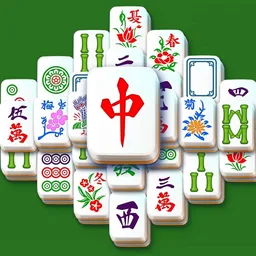
- The tiles are stacked into a layout. The classic one is the “Turtle” (sometimes called the Dragon), built in several overlapping layers.
- Three suits run 1–9 with four copies each: Circles (dots), Bamboo (sticks), and Characters.
- Next come the Winds (East, South, West, North) and the Dragons (Red, Green, White).
- Two small special groups finish the set: Flowers and Seasons.
- Every tile starts face-up, so you can see the whole board. Most tiles are blocked by their neighbors, though.
The one rule that matters: free tiles
A tile can only be removed when it is free (also called “open”). A tile is free when both of these are true:
- Nothing is stacked on top of it.
- At least one long side, left or right, is clear, so you could slide it straight out.
A tile pinned between two others on both sides, or buried under a tile above, is blocked. Freeing those blocked tiles is the entire puzzle.
How to play, step by step
- Scan the layout for free tiles. They’re usually along the top layer and at the ends of rows.
- Find two free tiles that match and select them to remove the pair.
- Removing a pair frees the tiles beneath and beside them, which opens new moves.
- Keep matching pairs until the layout is empty. That’s a win. If no free pair is left, the board is stuck.
Mahjong solitaire rules for matching (and the two exceptions)
Most tiles match only their exact twin. A 5 of Bamboo pairs with another 5 of Bamboo, the Red Dragon with the Red Dragon, the East Wind with the East Wind, and so on.
Two groups work differently:
- Flowers all match each other. Any Flower pairs with any other Flower.
- Seasons all match each other. Any Season pairs with any other Season.
So you never need two identical Flowers. Any two Flowers clear together, and the same goes for Seasons. These flexible tiles act as small lifelines, so it’s worth knowing which ones they are.
Is it the same as “real” mahjong?
No, and this trips up a lot of newcomers. Classic mahjong is a four-player game where you draw and discard tiles to build a winning hand, a bit like rummy. Mahjong Solitaire borrows only the tiles. Like the card game solitaire, it’s a solo puzzle of patience and planning. That’s why so many people searching for solitaire and mahjong are really after this relaxing single-player version rather than the social table game.
Strategy and tips
The rules take a minute to learn. The skill comes from how you order your moves.
- Unblock before you clear. Prefer the pair that frees the most new tiles, not just the first match you spot.
- Dig from the top. Peel off the upper layers early so the tiles beneath become reachable, rather than clearing easy edges first.
- Mind the tiles that come in fours. When three copies of a tile are free at once, removing the wrong pair can strand the fourth under a stack. Match the two that open up more of the board.
- Don’t spend Flowers and Seasons too soon. They’re flexible, so save a flexible match to break a future deadlock instead of burning it on an easy opening.
- Look ahead, not just now. Before you take an obvious pair, check that you’ll still have a legal move afterward. Many boards are lost to greedy clearing.
- Use undo and shuffle wisely. Most digital versions let you undo a slip or reshuffle a dead board. That’s handy for learning, though a pure solve avoids them.
If you enjoy calm, think-ahead puzzles like this one, our Sudoku guide makes a good next stop.
Putting it into practice
Start with the classic Turtle layout and spend your first few games just scanning for free tiles before you click anything. Once spotting open pairs feels automatic, shift your attention to which pair opens the most tiles underneath. That single habit separates a cleared board from a stuck one.
Mahjong Solitaire rewards patience far more than speed. Learn the free-tile rule, keep your options open, and clear the top layers first. Do that, and even the big Turtle layout comes apart one pair at a time. Set up a board and give it a go.
FAQ
What makes a Mahjong Solitaire tile 'free'?
A tile is free when nothing is stacked on top of it and at least one long side — left or right — is open, so you can slide it out. Only free tiles can be matched and removed.
Do Flower and Season tiles have to be identical to match?
No. Any Flower matches any other Flower, and any Season matches any other Season. Every other tile must be matched with its exact twin.
Is Mahjong Solitaire the same as Mahjong?
No. Mahjong is a four-player draw-and-discard game; Mahjong Solitaire is a solo puzzle that only uses the same tiles, matching free pairs to clear a layout.