How to Play Minesweeper — Rules, Numbers & Setup
Learning how to play Minesweeper comes down to one goal: reveal every safe cell on the grid without uncovering a mine. Each number you uncover counts the mines touching that cell, and those counts let you work out where the mines are by logic alone.
▶ Play Minesweeper — Find your focus free →If you have ever stared at a grid of grey squares and wondered where to click first, this guide on how to play Minesweeper is for you. The rules fit in a sentence, but the deduction underneath is what keeps people coming back for decades. Below you’ll find the setup, the number meanings, a step-by-step routine and a few habits that make early boards easier.
The goal and the setup
Minesweeper is played on a rectangular grid of covered cells. A fixed number of those cells hide mines, and the rest are safe. The goal is to reveal every safe cell without ever uncovering a mine. Uncover one mine and the game ends immediately.
The standard difficulty levels set the board size and mine count for you:
- Beginner — a 9×9 grid with 10 mines.
- Intermediate — a 16×16 grid with 40 mines.
- Expert — a 16×30 grid with 99 mines.
You never place the mines yourself; the game hides them at random. In a no-guess edition like this one, the layout is also guaranteed to be solvable by pure logic, so you never have to flip a coin and hope.
Minesweeper rules: what the numbers mean
The core minesweeper rules are about what happens when you reveal a safe cell. One of two things appears:
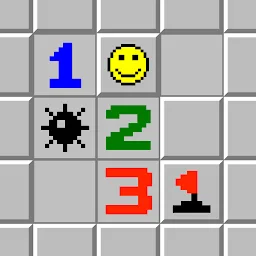
- A number from 1 to 8. It counts the mines in the eight cells touching it: up, down, left, right and the four diagonals.
- A blank cell (a zero). None of its neighbors are mines, so the game opens all of them automatically. That cascade is why one lucky click can clear a big chunk of the board.
If you’re wondering what do the numbers mean in Minesweeper, the answer is that they are the whole game. A “1” next to a single covered cell points straight at a mine. A “2” touching exactly two covered cells means both of them are mines.
How to play, step by step
- Make your first click. It is always safe, so click anywhere. A central cell often opens a larger area.
- Read the numbers around the opening. Look at each number on the border of the revealed region and count the covered cells it touches.
- Deduce the mines. If a number equals the count of covered cells beside it, every one of those cells is a mine. Flag them (right-click on desktop, long-press on mobile) so you don’t click them later.
- Deduce the safe cells. Once a number already has all of its mines flagged, every other covered cell it touches is safe. Click them to reveal more numbers.
- Repeat around the growing border until every safe cell is open. That’s the win.
Minesweeper for beginners: strategy and tips
These habits matter most when you’re new to the game.
Count, don’t guess
Pick a number on the edge of the opened area and compare it to the covered cells next to it. Two deductions will solve most of the board on their own: “number equals covered neighbors, so all are mines” and “mines already flagged, so the rest are safe.”
Learn the 1-1 and 1-2-1 patterns
Along a straight edge, two adjacent “1”s often prove that a cell further along is safe. A “1-2-1” row almost always means the mines sit under the two 1s, with the middle clear. Spotting these patterns turns slow counting into instant reads.
Work the whole frontier
Stuck in one corner? Move to another part of the border. A number that was ambiguous earlier often becomes obvious once nearby cells are revealed.
Use flags as memory, not decoration
Flagging keeps you from misclicking a known mine, and it makes the “all mines accounted for” deduction visible at a glance. On a no-guess board, if you feel forced to gamble, stop. There is always a logical move somewhere else, so slow down and find it.
Don’t rush the clock
Speed comes from recognizing patterns, not from frantic clicking. One wrong click ends the run, so a steady, deliberate pace is faster over a whole game.
Where to go next
Once you can clear Beginner without a single guess, the natural next step is tightening your deductions and your time. Our companion guide, how to win at Minesweeper, goes deeper into advanced patterns and speed technique.
To put it into practice, open a board, start in the middle, and read the numbers one border cell at a time. Flag what the counts prove, click what they clear, and your first finished grid will arrive sooner than you expect.
FAQ
What do the numbers in Minesweeper mean?
A number tells you how many mines are hidden in the eight cells touching it — the squares above, below, left, right and on all four diagonals. A '3' means exactly three of those neighbours are mines.
Is the first click in Minesweeper always safe?
In modern versions, yes. Your very first click is never a mine, and it usually opens a blank area to give you something to work from. A no-guess board goes further and guarantees the whole puzzle is solvable with logic.
Do you have to flag every mine to win Minesweeper?
No. You win by revealing every cell that is not a mine. Flags are just markers to help you remember where mines are and to avoid clicking them by accident — they don't count toward winning.