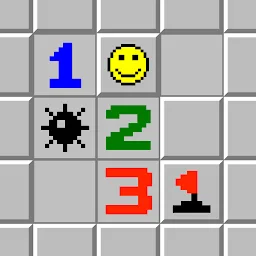
How to Win Minesweeper: Strategy, Patterns & Tips

The best minesweeper strategy is to treat every number as a logic clue instead of guessing: a number equal to its flagged neighbors means the rest are safe, and a number equal to its unopened neighbors means they are all mines. Learn the 1-2-1 and 1-2-2-1 patterns and the mine-counter trick, and most boards, including Expert, can be solved by deduction alone.
▶ Play Minesweeper — Find your focus free →Minesweeper looks like luck, but strong players rarely guess. A solid minesweeper strategy rests on one idea: the board is a logic puzzle, every number is a clue, and a handful of patterns turn those clues into certain moves. If you want to know how to win Minesweeper consistently, start by learning to read them.
Read the numbers
Each revealed number counts the mines among its neighboring cells, up to eight of them. Two rules follow right away:
- If a number already touches that many flagged mines, every other neighbor is safe. Open them.
- If a number has exactly that many unopened neighbors left, they are all mines. Flag them.
Alternate between these two checks and you will solve most of the board.
Start smart
Open a corner or edge first, or wherever you can clear the largest blank area. Big open regions reveal the most numbers to work with. On our no-guess boards, the first click is always safe and the whole grid can be solved by logic, so you never have to gamble.
Learn the key patterns
A few minesweeper patterns do much of the heavy lifting on walls of numbers.
1-1 (edge). Two 1s in a row along the edge of opened cells: the cell past the pair is usually safe, because both 1s already “see” the same shared mine.
1-2-1. The minesweeper 1-2-1 pattern is a run of 1-2-1 along a straight edge. The cells beneath the 1s are mines, and the cell beneath the 2 is safe. This is always true.
1-2-2-1. The cells beneath the inner 2s are mines, and the ends are safe.
Memorizing just 1-2-1 and 1-2-2-1 will crack the majority of tricky walls.
Counting: the endgame trick
Late in a board, check the mine counter. Suppose you know only N mines remain, and a border has exactly N candidate cells that must hold them. Then every other unopened cell is safe. Subtracting known mines from the total often breaks a position that looks unsolvable.
A reliable solving loop
- Open the biggest safe area you can.
- Flag every number whose unopened neighbors all must be mines.
- Open every number that already touches all its mines.
- Apply 1-2-1 / 1-2-2-1 on walls.
- Use the global mine count for the final cells.
- Repeat 2–5 until solved.
Minesweeper tips for going faster
These minesweeper tips help once the logic feels natural:
- Flag accurately, not everything. Speed players often skip flags and open known-safe cells directly.
- Work the edges and corners. They have fewer neighbors, so deductions are cleaner.
- If you are truly stuck on a guess, pick the cell with the lowest mine probability. On logic-solvable boards, you shouldn’t need to.
See the numbers as a running tally and the patterns as shortcuts, and Expert boards go from terrifying to routine.
FAQ
What do the numbers mean in Minesweeper?
A number tells you how many mines touch that cell among its (up to) eight neighbours. A 3 means exactly three of the surrounding cells are mines.
How do you win Minesweeper without guessing?
Open a large area first, then use the numbers and patterns like 1-2-1 to deduce safe cells. Our no-guess boards are always solvable by logic alone.
What is the 1-2-1 pattern?
Along an edge, a 1-2-1 run means the two cells under the 1s are mines and the cell under the 2 is safe — a guaranteed deduction.